
June 18, 2026
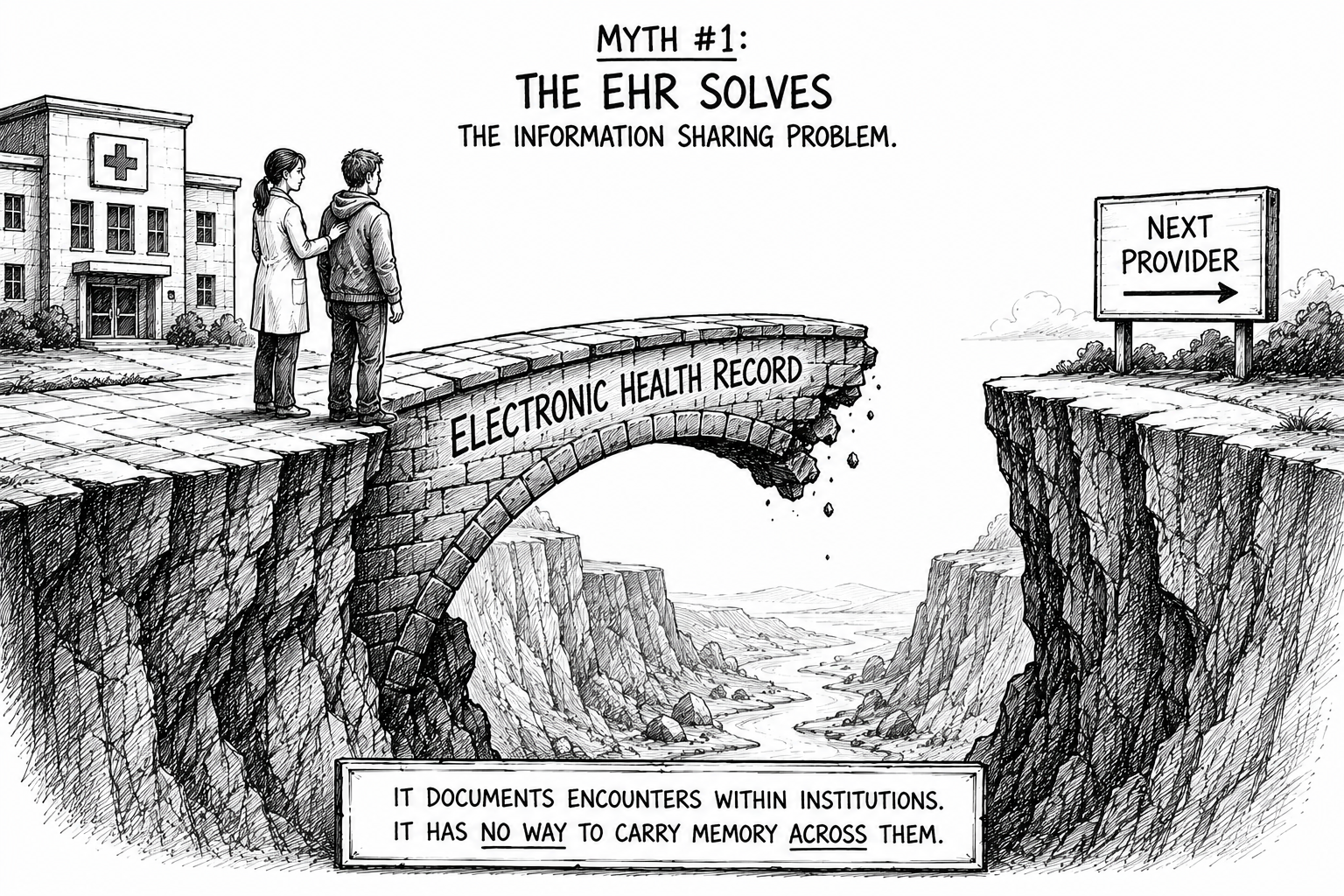
Ask any clinical director whether their organization has an information sharing problem, and many will say no. They have an EHR. Their staff documents consistently. Their system is connected to the regional health information exchange.
The record exists. Therefore, the information is available.
This assumption is understandable. It is also empirically false, and its consequences are not administrative. They are clinical. They are safety-related. And they are happening inside your organization right now.
What the Research Actually Shows
In 2016, a landmark study published in the Journal of the American Medical Informatics Association examined what a large, integrated EHR system actually knew about its own patient population (Madden et al., 2016). The finding was staggering:
The system was missing 89% of acute psychiatric events experienced by the patients it was supposed to be tracking.
Nearly nine out of ten psychiatric hospitalizations, crisis presentations, and acute mental health events were invisible to the treating outpatient clinician. Not because no one documented them, but because they happened at a different facility, inside a different system, behind a different login.
The record existed. It simply wasn't there when it was needed.
That was 2016. That gap has not closed.
A national survey (Chang & Owusu-Mensah, 2026) of more than 21,000 behavioral health and substance use treatment facilities found that only 19% participate in a health information exchange (HIE). More than two-thirds of non-participating facilities reported being unaware that an HIE even exists in their area. The structural conditions that produced the 89% figure remain in place.
Consider what this means at the point of clinical decision-making. A psychiatrist assessing a new patient for depression, unaware that the same patient was hospitalized for a manic episode eighteen months ago at a different health system, is not simply operating with incomplete data. The more precise problem is that they do not know they are. The EHR does not flag what it cannot see. The chart appears complete. The clinician has no reliable signal that the record in front of them is missing the majority of the patient's prior acute psychiatric events. They are operating in a condition of diagnostic blindness, one the system actively conceals.
We do not accept this standard in other areas of medicine. A surgeon who proceeds without knowing about a patient's prior adverse drug reaction is not considered inefficient. They are considered unsafe. The 89% blindspot in behavioral health EHRs deserves the same classification.
The Patient Side of the Same Problem
The information sharing failure isn't only visible to researchers. Patients live it at every appointment, though they might not have the language to describe it as a systemic safety failure.
Many patients describe the need to repeat their medication trials, past diagnoses, and clinical histories at every new encounter as a personal frustration, something the system quietly normalizes as an inevitable feature of care. For patients with serious chronic illness, it is not frustration. It is a safety problem.
A qualitative study by Kern and colleagues (2019) documented something that should stop every clinical director cold: Patients have no reliable way to confirm which of their providers can access their health records. More importantly, they have no reliable mechanism to put their doctors in touch with one another. Imagine what this means for patients with chronic illness.
Patients with serious mental illness often must meet with a psychiatrist, a primary care physician, a substance use counselor, at least one medical specialist, and a case manager. There is no simple way for these provider to verify what the others know. The patient is the only node in the network with the full picture, and in practice they are asked time and again to recount the clinical memory themselves, verbally yet efficiently, during each appointment, with no mistakes or omissions.
Sometimes our system asks this of patients in the very moments when their illness makes that impossible.
When the patient cannot remember a medication name, or cannot recall exactly when a prior hospitalization occurred, or simply doesn't know that the information they are carrying is clinically significant, the illusion that the system has been paying attention disappears. The patient was not a gap in the system. The patient was the system.
This is not an edge case. This is the standard of care.
Composition vs Synthesis: Having Data Is Not the Same as Having Memory
There is a distinction that the EHR industry has never fully grappled with, and that behavioral health organizations are only beginning to name. Researchers call it the composition vs. synthesis gap (Kariotis et al., 2022).
EHRs excel at composition — recording discrete data points at the moment of encounter. A medication prescribed. A diagnosis coded. A note dictated. The system captures what happened in the room.
What EHRs do not do — and were never designed to do — is synthesis: connecting those discrete data points across time, across providers, and across institutions into a coherent longitudinal clinical narrative. The data exists as fragments. The fragments do not assemble themselves into a story.
For some specialties, this gap is an operational inconvenience. For behavioral health, where symptom trajectories span years, where a patient’s life story necessarily informs every subsequent encounter, where historical medication responses are foundational to safe prescribing, and where patients often must regularly meet with multiple providers across different institutions, the synthesis gap is not an inconvenience. It is a structural condition that places patients at risk every time a clinician opens a chart and mistakes composition for memory.
The Filing Cabinet Problem
The EHR is the most sophisticated filing cabinet in healthcare. It stores information with remarkable fidelity inside the institution that created it.
But fidelity is not the same thing as effectiveness. A filing cabinet in one building does not protect the patient being treated in the next building. And it does not protect the patient who has no way of knowing whether the story from their last hospitalization — the one that happened three years ago, at a different health system, in a different state — was ever shared at all.
The question is not whether your organization documents well. Most behavioral health organizations do. The question is whether that documentation is present and synthesized at the precise moment a clinician needs it to make a safe treatment decision.
For 89% of acute psychiatric events, the answer is no.
That is not a documentation problem. It is a patient safety problem. And it will not be solved by documenting more carefully inside the same fragmented infrastructure.
What About Health Information Exchanges?
The most common counterargument: yes, the EHR does not travel between buildings, but health information exchanges do. If your organization participates in an HIE, doesn't the record follow the patient?
Two things worth naming precisely. First, as of 2024, only 19% of behavioral health and substance use treatment facilities participate in a regional or state HIE. And, more than two-thirds of the rest are unaware if one exists in their area (Chang & Owusu-Mensah, 2026). The interoperability the field describes as an emerging solution remains inaccessible to the majority of the sector delivering care.
Second, and more fundamentally: routing records is not the same as synthesizing them. An HIE that successfully delivers 87 pages of prior records from connected systems has helped the data travel. It has not solved the critical question: what’s going on with the patient today, and what exactly do I need to know to deliver great care? In other words, even when the HIE is connected and working, the longitudinal clinical picture is missing. A later installment in this series addresses that ceiling directly.
What This Means for Your Organization
The information sharing problem is not solved by having an EHR or AI medical scribe. It is not solved by joining a health information exchange. It is not solved by more consistent documentation practices or more rigorous staff training.
It is solved by building infrastructure that synthesizes the clinical narrative across every encounter — not just within your system, but across every care point your patients visit. Infrastructure that travels with the patient. Infrastructure that remembers. Infrastructure that closes the diagnostic blind spot before a clinician has to make a decision in the dark.
Until that infrastructure exists, the record will continue to exist. The information will continue to be unavailable. And the gap between those two facts will continue to produce harm that no one in behavioral health set out to cause, but that the current architecture quietly guarantees.
___
This is the first in a developing series examining the assumptions that are preventing behavioral health organizations from solving their most consequential patient safety problem.
Next: why two decades of EHR adoption have made fragmentation worse, not better — and the mathematical reason no amount of additional adoption will change that.
Featherglass Health builds clinical memory infrastructure for high-acuity behavioral health organizations. Download our clinical intelligence brief, Beyond the AI Scribe, to read the full evidence base behind this series.
___
References:
Chang W, Owusu-Mensah P. Electronic health record adoption and exchange capabilities among substance use and mental health treatment facilities, 2024. ONC Data Brief No. 82. April 2026.
Madden JM et al. Missing clinical and behavioral health data in a large electronic health record (EHR) system. JAMIA. 2016;23(6):1143–1149.
Kern LM et al. Patients' and providers' views on causes and consequences of healthcare fragmentation in the ambulatory setting. J Gen Intern Med. 2019;34(6):899–907.
Kariotis TC et al. Impact of electronic health records on information practices in mental health contexts: scoping review. JMIR. 2022;24(5):e30405.