
August 26, 2026
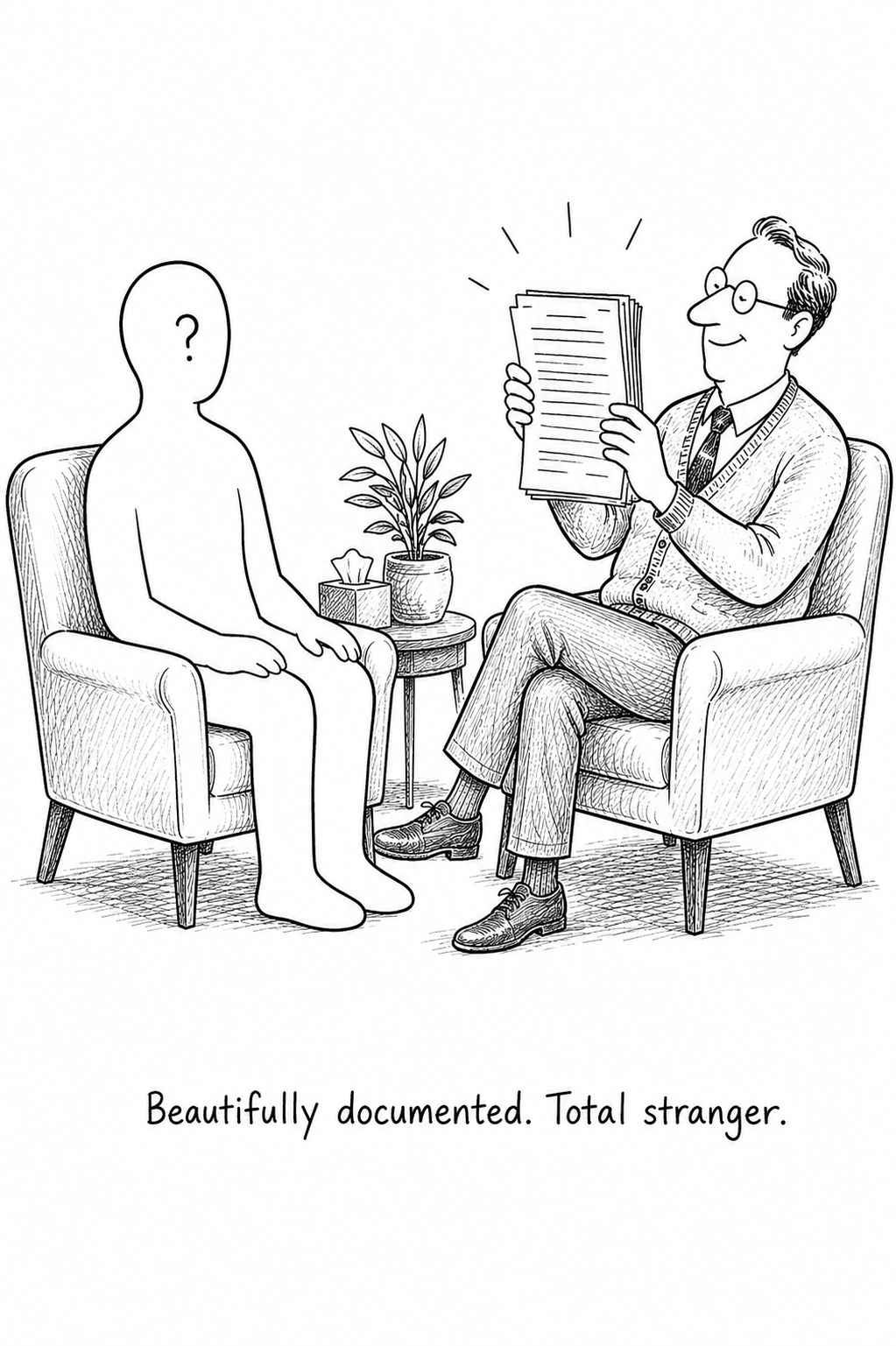
Why the largest study of AI scribe adoption shows the real problem was never documentation. It was the narrative, the patient's story that no scribe carries across settings.
The AI scribe market arrived with a compelling promise. Clinicians are drowning in documentation. Ambient AI can listen to the encounter, generate the note, and give clinicians their time back.
And now, for the first time, we have the data to evaluate whether the promise held.
It did not, at least not at the scale or in the dimensions that matter most for behavioral health. The more important finding is not what the technology failed to do. It is what organizations now believe it has already solved. The answer behavioral health needs is not a faster scribe but a Common Point of Care, where a patient's narrative is coordinated by design rather than pieced together after the fact.
The Largest Study Ever Conducted on AI Scribe Adoption
In 2026, Rotenstein and colleagues published in JAMA the most comprehensive evaluation of AI-powered scribe adoption to date: 8,581 clinicians across five academic health systems, tracking time expenditure and visit volume before and after scribe deployment.
The complete findings are worth reading. Clinicians using AI scribes saved an average of 16 minutes per day on documentation, roughly a 10 percent relative reduction, and saw about half an additional patient visit per week.
These are real gains. They are also modest ones.
The more telling finding is what the scribes did not change. After-hours EHR time, the metric most directly tied to clinician burnout, commonly called "pajama time," showed no meaningful reduction. The study's authors concluded that the observed gains were unlikely to fully explain the burnout improvements often attributed to these tools.
Clinicians were typing 16 minutes less during the workday but were not meaningfully escaping the EHR after hours. The documentation burden redistributed; it did not resolve.
This points to the deeper issue: faster transcription does nothing for the task that consumes the most clinical time and carries the greatest risk downstream, reconstructing the patient's narrative, a coherent clinical picture, from a record that was not designed to provide one.
The pipeline got faster at one end, and the bottleneck just moved downstream. If typing was not the true constraint, what was?
The Financial Case, Quantified
For organizations that justified AI scribe adoption on financial grounds, the visit-volume gain is worth translating into dollars. Based on the roughly half-visit-per-week increase documented in the study, an estimate of the marginal revenue attributable to AI scribe adoption is on the order of $167 per month per adopting clinician.
This is not nothing. But it is also not transformative in terms of improving revenue, productivity, or access.
This is not a fringe reading of the evidence. In JAMA’s analysis of what ambient AI scribes actually deliver, Tierney and colleagues reflected that scribes make modest progress on one aim, the documentation burden, while leaving the others, including care continuity and coordination, untouched.
What gets counted is not the same as what matters in care. Transcription was not built to close that gap.
What a Scribe Cannot Know
The limitation of current AI scribes is architectural. Transcription alone, however accurate, fast, or integrated into clinical workflows, is only a record of what happened in this room, during this encounter, between this clinician and this patient today.
Rotenstein and colleagues' results show that this level of functionality does not extend far enough: not for clinicians, who continue to drown in the EHR after hours; not for health systems working on thin margins; and not for patients, for whom accessing and navigating our care system remains as fraught and demoralizing as ever.
AI scribes lack meaningful contextual awareness. Some messaging about “context awareness” focuses on improving AI’s understanding of what’s happening in the room right now. Yet, the context that matters is the patient’s life story, illness story, and treatment team. This is the narrative, and it lives outside the encounter the scribe records.
Existing tools don’t know what happened in the room during the last twelve encounters. They cannot access the hospitalization that occurred two years ago at a different health system. They cannot retrieve the medication trial that failed at a previous practice, or the trauma disclosure made to a prior therapist, or the manic episode that was documented once, at a facility the patient visited in crisis and never returned to. They do not try to deal with the complexities of addiction histories and the enhanced compliance needed to handle them responsibly.
In behavioral health, a scribe may capture today's visit perfectly while the clinician stays blind to a prior psychiatric history that is often deeply incomplete, up to 89 percent of it missing from the record. Transcribing the visit has not made the patient safer.
Understanding the patient's full treatment story matters in behavioral health, where the clinical record needs to act not as a snapshot but as a timeline, and where the most consequential information, such as a history of overdose, often lives outside the current encounter or treatment relationship. A diagnosis of unipolar depression, made by a clinician working from an accurately transcribed encounter but without access to a documented history of mania elsewhere, is not made correct by being well transcribed. It remains an incorrect diagnosis, with all the clinical ramifications described earlier in this series.
The False Sense of Resolution
Perhaps the most concerning problem with current AI scribes is not what they fail to do. It is the illusion they create that a problem has been solved.
An organization that has adopted a scribe and measured some documentation relief tends to consider the AI question handled. The clinicians may be less frustrated, the notes may be faster, the procurement looks vindicated. The likelier dynamic is subtler than fragmentation being pushed off the agenda, since it was rarely on the agenda to begin with. Every new vendor and AI tool adds governance overhead, and responsible-use frameworks from CHAI, the APA, and others reasonably push organizations to consolidate rather than add tools. A scribe already in place makes the deeper infrastructure a harder internal sell, even though it solves a different problem.
And the underlying patient safety problem gets harder to see, not easier. The signals that fragmentation is causing harm, the after-hours chart review, the redundant history-gathering, the diagnostic errors that follow from cross-sectional snapshots, are partly masked by the efficiency gains at the surface. The filing is faster; the records are still fragmented; the harm is still accumulating. The urgency to fix it has been partly spent on a tool that was not built to fix it.
This is why it matters to be clear about what scribes solve and what they do not. Not to diminish real, if modest, relief, but to keep that relief from becoming the reason that deeper investment gets deferred: the infrastructure that would close the diagnostic blind spot, cut the burden of reconstructing a record, make the records portable, and address the patient safety consequences documented in the mortality literature.
What the Next Generation Requires
The Rotenstein data is not an argument against AI in clinical documentation. It is an argument for clarity about which problem AI is being asked to solve.
The problem that AI scribes solve is transcription latency, the delay between what happens in a clinical encounter and when it appears in the record.
The problem that these scribes do not solve, and that the behavioral health system most urgently needs solved, is narrative fragmentation: the structural absence of a synthesized longitudinal clinical memory that travels with the patient across settings, providers, and care episodes, and is present and accessible at every point where a clinician needs to make a safe treatment decision.
Solving transcription latency without solving narrative fragmentation is like installing a faster printer in a hospital where the records themselves are missing. The output is cleaner. The clinical picture is not more complete.
The infrastructure need is not a faster typist. It is a clinical memory engine, one that synthesizes the longitudinal narrative, makes the prior history visible, and provides every treating clinician with the full picture at the moment they need it. Not a faster way to document what happened today. A way to know what happened before.
It is worth acknowledging the field's current best answer to the continuity failure this data exposes. The warm handoff, a direct, structured communication between clinicians at a care transition, has emerged as behavioral health's most widely endorsed coordination intervention. When implemented consistently, a warm handoff at discharge does reduce some of the information loss that otherwise occurs at transition.
Available evidence is promising but limited: Taylor and Minkovitz (2021) found that most studies of warm handoffs showed improved receipt of services compared with standard referral, while noting how few rigorous studies exist and how often standard referrals fail to communicate essential health information. This matters, and it is not a reason to dismiss what the field has built. It is a ceiling. Warm handoffs require clinician time, relationships, and live availability that cannot scale across the transition volumes of a high-census behavioral health system. They address person-to-person communication at a single moment. They do not build the structural substrate that carries clinical knowledge across every moment before and after a care transition occurs.
What the next generation of behavioral health infrastructure requires has a name. A Common Point of Care, the full clinical community surrounding a patient across their entire care journey, can only work when information travels with the patient across every provider in the village, without becoming locked in any one facility.
Structural Coordination is the practice of building information architecture capable of holding that picture together: not relying on any individual clinician's memory, warm handoff success, or documentation practice, but creating a persistent, longitudinal clinical memory that surfaces at every point of care across every transition. This is what the next generation of clinical infrastructure is built to enable, not a faster scribe for isolated visits, but a memory that accumulates across every day that came before.
This is the fourth in a series examining the assumptions preventing behavioral health organizations from solving their most consequential patient safety problem. Next: the case that coordinated care for patients with serious mental illness is not failing for lack of effort, and the counterfactual evidence that the current utilization crisis is structurally produced, not clinically inevitable.
Featherglass Health builds clinical memory infrastructure for high-acuity behavioral health organizations. Download our clinical intelligence brief, Beyond the AI Scribe, to read the full evidence base behind this series. featherglass.com/resources
References
Rotenstein, L. S., Holmgren, A. J., Thombley, R., Sriram, A., Dbouk, R. H., Jost, M., ... & Mishuris, R. G. (2026). Changes in clinician time expenditure and visit quantity with adoption of artificial intelligence–powered scribes: a multisite study. JAMA, 335(16), 1408-1417.
Tierney, A. A., Lee, K., & Liu, V. X. (2026). Ambient AI Scribes and the Quintuple Aim: What Is Counted—and What Matters. JAMA, 335(16), 1393-1395.
Madden JM, Lakoma MD, Rusinak D, Lu CY, Soumerai SB. Missing clinical and behavioral health data in a large electronic health record system. JAMIA. 2016;23(6):1143-1149.
Taylor RM, Minkovitz CS. Warm handoffs for improving client receipt of services: a systematic review. Maternal and Child Health Journal. 2021;25:528-541.
Prior A, Vestergaard CH, Vedsted P, et al. Healthcare fragmentation, multimorbidity, potentially inappropriate medication, and mortality: a Danish nationwide cohort study. BMC Medicine. 2023;21(1).