
July 7, 2026
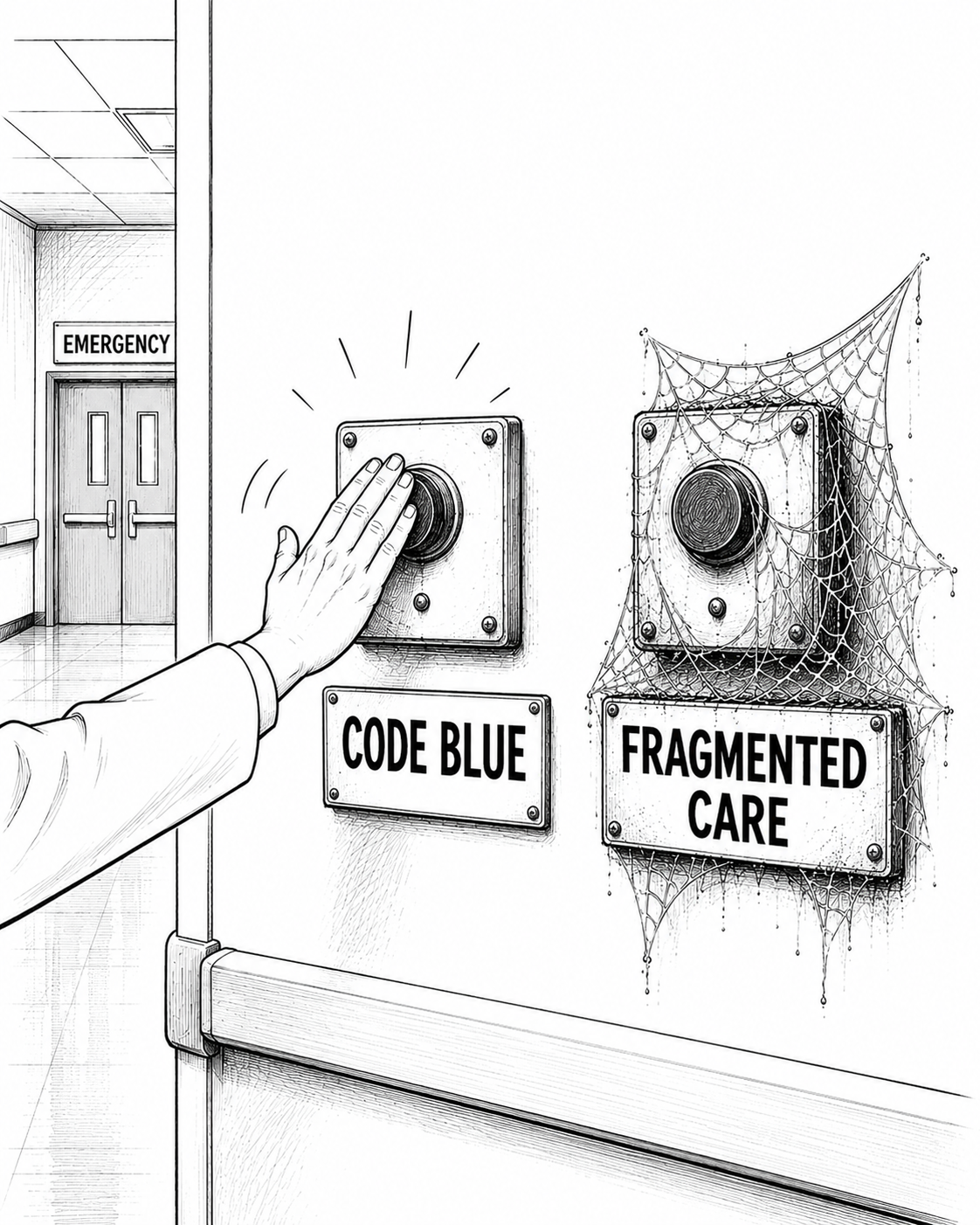
There is a familiar way of framing fragmentation in behavioral health, one that offers a certain reassurance:
"Yes, our systems are imperfect. Yes, information doesn't always travel the way it should. But patients are still receiving care. Clinicians are still making decisions. The quality of that care could be better — but we are not talking about life and death..."
This framing is wrong. Fragmentation kills. It does so through a mechanism that is traceable, preventable, and structural. And the evidence that it does so has been sitting in the peer-reviewed literature long enough that continuing to classify it as a quality issue rather than a patient safety crisis is no longer a defensible position.
The Number That Reframes the Conversation
In 2023, Prior and colleagues published a nationwide cohort study examining the relationship between healthcare fragmentation and mortality across a large Danish patient population. Their finding is the anchor of every fragmentation conversation that takes patient safety seriously: patients with highly fragmented care carry a 2.5 times greater mortality hazard ratio than those receiving coordinated care — independent of disease severity.
This is not a correlation between sicker patients and worse outcomes. The researchers controlled for disease severity. The excess mortality is attributable to fragmentation itself — to the structural condition of receiving care across disconnected systems, with no shared clinical memory, no coordinated decision-making, and no infrastructure to synthesize the longitudinal narrative that safe treatment requires.
A 2.5x mortality hazard ratio is not a quality metric. It is a patient safety statistic. It belongs in the same conversation as surgical complication rates, medication error frequencies, and hospital-acquired infection data. It belongs on the agenda of every risk management committee, every patient safety officer, and every clinical director who has accepted fragmentation as an inevitable feature of behavioral health rather than a preventable cause of death.
But a hazard ratio without a mechanism is just a number. The Prior finding becomes truly actionable when you understand the chain of events that produces it — and that chain begins with a statistic from Article 1 of this series.
The Chain Begins with Diagnostic Blindness
As we documented earlier, Madden and colleagues (2016) found that a large integrated EHR system was missing 89% of the acute psychiatric events experienced by its patient population. Nine out of ten hospitalizations, crisis presentations, and acute mental health episodes — invisible to the treating outpatient clinician.
This is the first link in the chain. A clinician conducting a psychiatric assessment without access to a patient's prior psychiatric history is not working with incomplete data. They are operating in a condition of diagnostic blindness — making treatment decisions from a cross-sectional snapshot of a patient whose longitudinal clinical story is stored in systems they cannot access, at institutions they may not know the patient visited, documenting episodes the patient may not remember or may not have thought to disclose.
In most clinical scenarios, a cross-sectional snapshot is sufficient. In behavioral health — where the diagnosis often depends on a pattern that only becomes visible across time, where a single prior episode changes the entire treatment calculus, where the difference between a correct and incorrect diagnosis can be the difference between stabilization and crisis — it is not.
The 89% blindspot does not produce 89% worse care. It produces specific, predictable, catastrophic failures for specific patient populations. And none is more documented, more preventable, or more consequential than what happens when a clinician meets a bipolar patient who presents as depressed.
The Bipolar Misdiagnosis Chain
Bipolar disorder is an episodic condition. Its defining feature — the manic episode that distinguishes it from unipolar depression — may occur once every several years, may last only days to weeks, and may have been documented exclusively in a hospital the patient visited once, in a crisis, years before their current treatment relationship began. When that documentation is locked in a siloed external record — invisible to the clinician now conducting the assessment — the patient presents as someone with depression. Because in this encounter, in this moment, that is what they appear to be.
The research on what happens next is unambiguous. Benacek and colleagues (2024) and Shen and colleagues (2018) independently documented that approximately 50% of individuals with bipolar disorder are initially misdiagnosed, most commonly as unipolar depression. This is not a clinician competency failure. The clinicians making these diagnoses are following evidence-based protocols for the presentation in front of them. It is a record completeness failure. The information that would correct the diagnosis is not absent from the clinical record because no one documented it. It is absent because the infrastructure cannot retrieve it.
The misdiagnosis, once made, sets a treatment pathway in motion. Standard antidepressant monotherapy is prescribed — the appropriate first-line intervention for unipolar depression, and a contraindicated intervention for unrecognized bipolar disorder. McIntyre and colleagues (2022) documented what follows. In patients with unrecognized bipolar disorder treated with antidepressant monotherapy, the pharmacological intervention does not produce stabilization. It produces rapid cycling and manic episodes — directly precipitated by the treatment itself. These episodes drive emergency department presentations, extended inpatient psychiatric admissions, and in the absence of mood stabilization, elevated crisis utilization that compounds over time.
The harm, in these cases, was not caused by the patient's illness. It was caused by a treatment decision made in the dark. This is iatrogenesis imperfecta — medical harm caused directly by information gaps. The fragmented record did not fail to help the patient. It actively generated the clinical crisis.
The Mortality Hazard Made Legible
Return now to the Prior (2023) finding: a 2.5x mortality hazard ratio for patients with highly fragmented care. The chain that produces that number is now visible.
Fragmented EHRs render 89% of prior psychiatric events invisible. Clinicians conducting assessments from cross-sectional snapshots misdiagnose bipolar disorder as unipolar depression in approximately half of all cases. Antidepressant monotherapy prescribed to unrecognized bipolar patients precipitates rapid cycling and manic episodes. Those episodes drive emergency presentations, extended hospitalizations, and compounding clinical instability. Across a large enough population, over a long enough timeline, that instability produces the mortality excess that Prior's hazard ratio captures.
The 2.5x figure is not a statistical abstraction. It is the aggregate outcome of a chain of preventable events, each link of which is traceable to a specific failure of clinical memory infrastructure. Every link in that chain is addressable. None of it is biologically inevitable.
A Second Mortality Pathway
The four-link chain above describes one mechanism by which fragmentation produces excess mortality — the diagnostic misidentification pathway. Prior and colleague's mortality data captures something larger. Research across large national samples has documented that adverse childhood experiences (ACEs)— early-life exposures including abuse, neglect, and household dysfunction — are associated with substantially elevated risk of suicidal behavior across the lifespan, in a consistent dose-response relationship.
Dube and colleagues (2001) found that ACEs are associated with 67 to 80 percent of all suicide attempts, with the relationship persisting after adjustment for the psychiatric and substance use conditions that partially mediate it. These are not statistical abstractions. They describe the highest-acuity patients in behavioral health settings — those whose clinical histories are most likely to span multiple institutions over years, and whose longitudinal records are most likely to be fragmented precisely because the complexity of their histories generated them across so many systems.
Critically, Putnam and colleagues (2013) established that ACEs also predict multimorbidity: individuals with four or more types of childhood adversity were more than seven times as likely to meet criteria for four or more concurrent psychiatric diagnoses, with specific adversity combinations producing synergistic effects (rather than simply additive ones) on clinical complexity.
The mortality risk thatPrior quantified is not evenly distributed across the behavioral health population. It concentrates in the patients whose histories are both most clinically consequential and least likely to be coherently present in the record at the moment those histories would most change the clinical picture.
The Financial Consequence of the Safety Failure
The patient safety argument is the primary one. But for organizations making infrastructure investment decisions, the financial consequence of the safety failure is worth naming precisely. Frandsen and colleagues (2015) found that chronically ill patients receiving highly fragmented care incur $4,542 more in annual healthcare spending than those receiving coordinated care — independent of disease severity. This is not the cost of treating sicker patients. It is the cost of treating the same patients less safely.
The excess spending is the financial signature of the iatrogenic harm chain: the emergency presentations, the inpatient admissions, the redundant medication trials, the extended disability. The fragmentation tax is real, it is measurable, and it is being paid by every health system, payer, and value-based care organization that has accepted fragmentation as a structural given rather than a solvable patient safety problem.
What a Safety Frame Requires
Classifying fragmentation as a care quality issue has a practical consequence: it places it in a queue of improvement initiatives, subject to competing priorities, incremental timelines, and the ordinary rhythms of organizational change management. Classifying it as a patient safety issue changes the category of response it requires.
Patient safety failures are not managed on improvement timelines. They are escalated. They trigger root cause analysis. They produce accountability structures. They create urgency that quality improvement cycles do not.
The Prior mortality data, the Madden blindspot data, the bipolar misdiagnosis chain, the McIntyre iatrogenic harm documentation, and the childhood adversity burden documented by Dube and Putnam collectively make the case that behavioral health fragmentation belongs in the second category — not because the language is more dramatic, but because the evidence demands it. A 2.5x mortality hazard ratio is not a quality metric. It is a safety signal. The infrastructure that produces it is not underperforming. It is causing preventable deaths. Naming it accurately is the first step toward building something that stops it.
This is the third in a multi-part series examining the assumptions preventing behavioral health organizations from solving their most consequential patient safety problem. Next: why AI scribes don't just fail to solve the documentation crisis — and why the false sense of resolution they create may be making the underlying safety problem harder to see.
Featherglass Health builds clinical memory infrastructure for high-acuity behavioral health organizations. Download our clinical intelligence brief, Beyond the Scribe, to read the full evidence base behind this series. → featherglass.com/resources
References
Prior A et al. Healthcare fragmentation, multimorbidity, potentially inappropriate medication, and mortality: a Danish nationwide cohort study. BMC Medicine. 2023;21(1).
Madden JM et al. Missing clinical and behavioral health data in a large electronic health record (EHR) system. JAMIA. 2016;23(6):1143–1149.
Benacek J et al. Identification of predictors of mood disorder misdiagnosis and subsequent help-seeking behavior in individuals with depressive symptoms. JMIR Mental Health. 2024;11:e50738.
Shen H et al. Analysis of misdiagnosis of bipolar disorder in an outpatient setting. Shanghai Archives of Psychiatry. 2018;30(2):93–101.
McIntyre RS et al. The real-world health resource use and costs of misdiagnosing bipolar I disorder. Journal of Affective Disorders. 2022;316:26–33.
Frandsen BR et al. Care fragmentation, quality, and costs among chronically ill patients. Am J Manag Care. 2015;21(5):355–362.
Dube SR, Anda RF, Felitti VJ, Chapman DP, Williamson DF, Giles WH. Childhood abuse, household dysfunction, and the risk of attempted suicide throughout the life span: findings from the Adverse Childhood Experiences Study. JAMA. 2001;286(24):3089–3096.
Putnam KT, Harris WW, Putnam FW. Synergistic childhood adversities and complex adult psychopathology. Journal of Traumatic Stress. 2013;26:435–442.